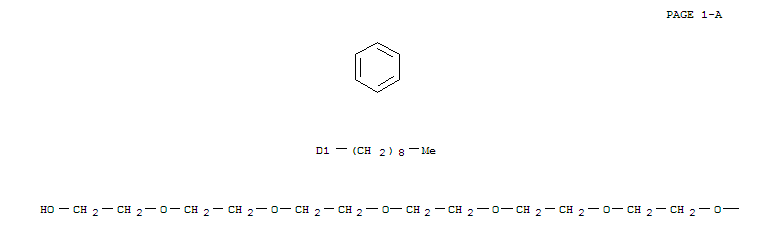
Section 1. Chemical Product and Company Identification
Nonoxynol-9
Common Name/
Trade Name
Manufacturer
Commercial Name(s)
Synonym
Chemical Name
Chemical Family
Nonoxynol-9
Section 4. First Aid Measures
Eye Contact Check for and remove any contact lenses. In case of contact, immediately flush eyes with plenty of water for
at least 15 minutes. Cold water may be used. Get medical attention if irritation occurs.
Skin Contact Wash with soap and water. Cover the irritated skin with an emollient. Get medical attention if irritation
develops. Cold water may be used.
Serious Skin Contact Not available.
Inhalation If inhaled, remove to fresh air. If not breathing, give artificial respiration. If breathing is difficult, give oxygen.
Get medical attention.
Serious Inhalation Not available.
Ingestion Do NOT induce vomiting unless directed to do so by medical personnel. Never give anything by mouth to an
unconscious person. Loosen tight clothing such as a collar, tie, belt or waistband. Get medical attention if
symptoms appear.
Serious Ingestion Not available.
Section 5. Fire and Explosion Data
Flammability of the Product May be combustible at high temperature.
Auto-Ignition Temperature Not available.
Flash Points CLOSED CUP: 197°C (386.6°F) - 238 C..
Flammable Limits Not available.
Products of Combustion Not available.
Fire Hazards in Presence of Slightly flammable to flammable in presence of open flames and sparks, of heat.
Various Substances Non-flammable in presence of shocks.
Explosion Hazards in Presence Risks of explosion of the product in presence of mechanical impact: Not available.
of Various Substances Risks of explosion of the product in presence of static discharge: Not available.
Fire Fighting Media SMALL FIRE: Use DRY chemical powder.
and Instructions LARGE FIRE: Use water spray, fog or foam. Do not use water jet.
Special Remarks on Not available.
Fire Hazards
Special Remarks on Explosion Not available.
Hazards
Section 6. Accidental Release Measures
Small Spill Dilute with water and mop up, or absorb with an inert dry material and place in an appropriate waste disposal
container. Finish cleaning by spreading water on the contaminated surface and dispose of according to local
and regional authority requirements.
Large Spill Absorb with an inert material and put the spilled material in an appropriate waste disposal. Finish cleaning by
spreading water on the contaminated surface and allow to evacuate through the sanitary system.
Section 7. Handling and Storage
Keep away from heat. Keep away from sources of ignition. Ground all equipment containing material. Do not
Precautions
ingest. Do not breathe gas/fumes/ vapor/spray. If ingested, seek medical advice immediately and show the
container or the label. Keep away from incompatibles such as oxidizing agents, acids, alkalis.
Storage Keep container tightly closed. Keep container in a cool, well-ventilated area.
Nonoxynol-9
Section 8. Exposure Controls/Personal Protection
Engineering Controls Provide exhaust ventilation or other engineering controls to keep the airborne concentrations of vapors below
their respective threshold limit value. Ensure that eyewash stations and safety showers are proximal to the
work-station location.
Personal Protection Safety glasses. Synthetic apron. Gloves (impervious). Respiratory protection is not necessary for normal
handling. Good room ventilation or use of local exhaust (fume hood) is sufficient. Use a vapor respirator
under conditions where exposure to the substance is apparent (e.g. generation of high concentrations of mist
or vapor, inadequate ventilation, development of respiratory tract irritation), and engineering controls are not
feasible. Be sure to use an approved/certified respirator or equivalent.
Personal Protection in Case of Splash goggles. Full suit. Boots. Gloves. Suggested protective clothing might not be sufficient; consult a
a Large Spill specialist BEFORE handling this product.
Exposure Limits Not available.
Section 9. Physical and Chemical Properties
Physical state and appearance Liquid. Odor Not available.
Taste Not available.
Molecular Weight Not available.
Colorless to light yellow.
Color
pH (1% soln/water) Not available.
Boiling Point 250°C (482°F)
5°C (41°F) - 6 C.
Melting Point
Critical Temperature Not available.
1.06 (Water = 1)
Specific Gravity
Vapor Pressure <0.1 kPa (@ 20°C)
Vapor Density >1 (Air = 1)
Volatility Not available.
Odor Threshold Not available.
Not available.
Water/Oil Dist. Coeff.
Ionicity (in Water) Non-ionic.
Dispersion Properties See solubility in water.
Solubility Soluble in cold water, hot water.
Section 10. Stability and Reactivity Data
Stability The product is stable.
Not available.
Instability Temperature
Conditions of Instability Avoid prolonged excess heat which may cause product decomposition.
Avoid incompatible materials such as strong bases strong acids, strong oxidizing agents and materials
reactive with hydroxyl compounds.
Incompatibility with various Reactive with oxidizing agents, acids, alkalis.
substances
Corrosivity Not available.
Special Remarks on Normally unreactive. However, avoid strong bases at high temperatures, strong acids, strong oxidizing
Reactivity agents, and materials reactive with hydroxyl compounds.
Special Remarks on Not available.
Corrosivity
Polymerization Will not occur.
Nonoxynol-9
Section 11. Toxicological Information
Routes of Entry Absorbed through skin. Eye contact.
Toxicity to Animals Acute oral toxicity (LD50): 3310 mg/kg [Rat].
Acute dermal toxicity (LD50): >2000 mg/kg [Rabbit].
Chronic Effects on Humans Not available.
Other Toxic Effects on
Slightly hazardous in case of skin contact (irritant, permeator), of ingestion, of inhalation.
Humans
Special Remarks on Not available.
Toxicity to Animals
Special Remarks on May cause adverse reproductive effects and birth defects (teratogenic) based on animal test data
Chronic Effects on Humans
Special Remarks on other Acute Potential Health Effects:
Toxic Effects on Humans Skin: May cause skin irritation. I may be absorbed through the skin, but not in harmful quantities.
Eyes: Can cause eye irritation.
Ingestion may cause abdominal discomfort, nausea, vomitting, and diarrhea. Aspiration into the lungs may
occur during ingestion or vomiting, resulting in lung injury. May affect behavior(somnolence, tremor),
respiratory system (acute pulmonary edema), and liver.
Inhalation: Inhalation of mist or vapor may cause irritation of the upper respiratory tract (nose, throat)
experienced as nasal discomfort and discharge with chest pain and coughing. Inhalation of mist or vapor may
also cause headache, nausea, drowsiness.
Chronic Potential Health Effects:
Skin: Prolonged or repeated skin contact may cause irritaiton and dermatitis.
Ingestion: Prolonged or repeated ingestion may affect the liver and metabolism (weight loss). Animal studies
also indicate that continuous exposure to high concentrations may be toxic to the kidneys.
Section 12. Ecological Information
Not available.
Ecotoxicity
Not available.
BOD5 and COD
Products of Biodegradation Possibly hazardous short term degradation products are not likely. However, long term degradation products
may arise.
Not available.
Toxicity of the Products
of Biodegradation
Special Remarks on the Not available.
Products of Biodegradation
Section 13. Disposal Considerations
For disposal of aqueous surfactant solutions: Aerobic biological wastewater treatment systems are effective in treating aqueous solutions of surfactants. Removal efficiency will depend upon treatment
Waste Disposal
plant conditions. As with any waste water, consultation with local treatment plant staff is recommended (and required by law). Before disposal, in activated sludge treatment systems, inlet
concentrations below 5 mg/l have been treated without foaming problems. For disposal of neat unused surfactant: Incinerate in a furnace where permitted under federal, state and local regulations.
Surfactants can cause foaming problems in biological treatment plants and other high shear operations.
For disposal of neat, unused surfactant, incinerate in a furnace where permitted under Federal, State, and Local regulations.
Dispose in accordance with applicable Federal, State, and Local environmental regulations. Empty containers should be recycled or disposed of through an approved waste management facility.
Section 14. Transport Information
DOT Classification Not a DOT controlled material (United States).
Identification Not applicable.
Special Provisions for Not applicable.
Transport
DOT (Pictograms)
Nonoxynol-9
Section 15. Other Regulatory Information and Pictograms
TSCA 8(b) inventory: Nonoxynol-9 (p-Nonylphenyl, ethoxylated
Federal and State
TSCA 8(a) PAIR: Nonoxynol-9 (p-Nonylphenyl, ethoxylated
Regulations
California California prop. 65: This product contains the following ingredients for which the State of California has
Proposition 65 found to cause cancer which would require a warning under the statute: No products were found.
Warnings
California prop. 65: This product contains the following ingredients for which the State of California has
found to cause birth defects which would require a warning under the statute: No products were found.
Other Regulations EINECS: This product is on the European Inventory of Existing Commercial Chemical Substances (EINECS
No. 247-816-5).
Canada: Listed on Canadian Non-Domestic Substance List (NDSL).
China: Not listed on National Inventory.
Japan: Not listed on National Inventory (ENCS).
Korea: Not listed on National Inventory (KECI).
Philippines: Not listed on National Inventory (PICCS).
Australia: Listed on AICS.
WHMIS (Canada) Not controlled under WHMIS (Canada).
Other Classifications
DSCL (EEC) R36- Irritating to eyes. S26- In case of contact with eyes, rinse
immediately with plenty of water and seek
medical advice.
Health Hazard
HMIS (U.S.A.) 1 National Fire Protection
1 Flammability
1 Association (U.S.A.)
Fire Hazard
1 0 Reactivity
Health
Reactivity
0
Specific hazard
Personal Protection
a
WHMIS (Canada)
(Pictograms)
DSCL (Europe)
(Pictograms)
TDG (Canada)
(Pictograms)
ADR (Europe)
(Pictograms)
Protective Equipment
Not applicable.
Lab coat.
Not applicable.
Safety glasses.
SECTION 16 - ADDITIONAL INFORMATION
N/A